

Safe to a Depth of Six Metres – EOD Clearance in the wadden sea, Germany
As part of Germany's energy transition towards achieving at least 80% renewable electricity generation by 2030, Amprion is developing critical offshore connection infrastructure to transmit wind power from the North Sea to the mainland.
Key Information
- Project name : UXO Clearance for Offshore Grid Connection – Wadden sea
- Client : Amprion (transmission system operator)
- Location : Lower Saxony Wadden sea, between German mainland and Langeoog Island
- Services provided: Unexploded ordnance (UXO) clearance to 6 metres depth, aerial and waterborne magnetic surveys, cone Penetration Test (CPT) with integrated magnetometry, real-time geophysical data evaluation, geotechnical site preparation and safety certification.

Talk to our experts

Amprion
Project Details
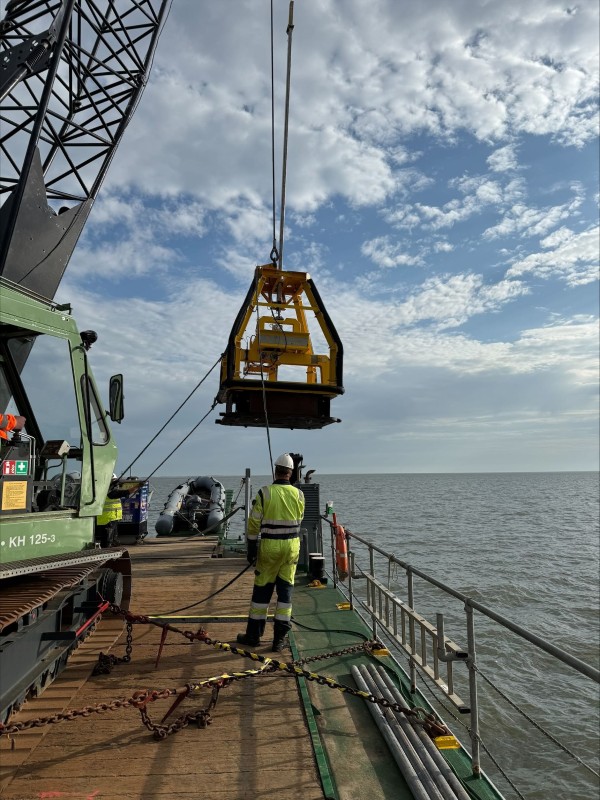
As part of Germany's energy transition, major infrastructure projects are currently being developed to transmit offshore wind power to the mainland. These projects play a key role in achieving the national goal of generating at least 80 percent of Germany's electricity from renewable sources by 2030, paving the way for a climate-neutral energy system. In this context, we were commissioned to ensure UXO clearance for construction sites required for a grid expansion project between the mainland and the East Frisian island of Langeoog.
The implementation of an offshore connection system as part of the Amprion (transmission system operator) cable route between the German mainland and the island of Langeoog required extensive safety measures in the Lower Saxony Wadden sea. The primary challenge was to guarantee complete UXO clearance down to six metres below ground level. Both large contiguous areas and specific point locations needed to be declared safe for subsequent geotechnical investigations. Additionally, the tidal conditions in the wadden sea imposed strict time windows and demanded highly efficient workflows.
Key project elements included :
- UXO clearance across large contiguous survey areas
- Deep clearance (6m bgl) at critical geotechnical investigation points
- Tidal-constrained operations requiring optimised workflows
- Integration of multiple survey technologies for comprehensive coverage
- Real-time safety monitoring and response protocols
As part of Germany's energy transition, major infrastructure projects are currently being developed to transmit offshore wind power to the mainland. These projects play a key role in achieving the national goal of generating at least 80 percent of Germany's electricity from renewable sources by 2030, paving the way for a climate-neutral energy system. In this context, we were commissioned to ensure UXO clearance for construction sites required for a grid expansion project between the mainland and the East Frisian island of Langeoog.
The implementation of an offshore connection system as part of the Amprion (transmission system operator) cable route between the German mainland and the island of Langeoog required extensive safety measures in the Lower Saxony Wadden sea. The primary challenge was to guarantee complete UXO clearance down to six metres below ground level. Both large contiguous areas and specific point locations needed to be declared safe for subsequent geotechnical investigations. Additionally, the tidal conditions in the wadden sea imposed strict time windows and demanded highly efficient workflows.
Key project elements included :
- UXO clearance across large contiguous survey areas
- Deep clearance (6m bgl) at critical geotechnical investigation points
- Tidal-constrained operations requiring optimised workflows
- Integration of multiple survey technologies for comprehensive coverage
- Real-time safety monitoring and response protocols
Combined Drone Surveying and CPT Technology
A multi-stage and highly efficient investigation strategy was deployed to ensure safe UXO clearance in the wadden sea. In the initial phase, large sections of the investigation area were surveyed from the air and water using drones and boats to detect UXO items of 100 lbs and above. These surface and waterborne surveys enabled UXO clearance down to four metres below ground level (bgl).
At specific point locations required for the subsequent geotechnical assessments, however, a deeper clearance down to six metres bgl was necessary. To bridge the gap between 4 m and 6 m bgl, a Cone Penetration Test (CPT) system equipped with an integrated three-axis magnetometer was used. This combined approach integrates geotechnical sounding and magnetic UXO detection into a single process. While the conical probe measures soil resistance and load-bearing capacity, the magnetometer simultaneously scans for ferromagnetic objects.
This method significantly increased efficiency by reducing the number of required drill holes and optimising operations within the tight tidal windows.
Due to the strong ferromagnetic mass of the CPT rig, magnetometer readings from the upper 2–3 metres were not evaluable, as the sensor was still within the system’s interference zone. However, since this depth range had already been fully cleared through the earlier surface surveys, no safety gaps were created. The CPT method therefore focused exclusively on the deeper layers beyond the initial survey depth.
Real-Time Data Evaluation
Throughout the CPT operations, all magnetic data was evaluated in real time on site by a qualified geophysicist certified under §20 of the German Explosives Act. This enabled immediate responses to any anomalies and, if necessary, the temporary suspension of work. Real-time analysis ensured the highest level of safety while maintaining efficient progress on site.
Result: Full Clearance and Enhanced Operational Safety
The combined investigation methods led to complete UXO clearance of the entire investigation area. The integration of surface surveys, drone and boat-based methods, and CPT technology delivered a safe, efficient and reliable assessment—meeting all requirements for the construction phase of this major energy infrastructure project.
Want to know more about our services in Germany ?

