

Water probing and unexploded ordnance inspection in Hanover's stormwater retention basins, Germany
The City of Hannover has planned the desludging of several stormwater retention basins in the Misburg district to increase usable capacity and improve water quality. Stormwater retention basins play a central role in flood protection for urban infrastructure by regulating water runoff, mitigating the effects of heavy rainfall, and contributing to the sustainable protection of water quality in the environment and waterways.
Key informations
- Period : January 2025 – August 2025
- Client : City of Hannover, Department of Urban Drainage
- Location : Anderter Straße in Hannover Misburg
- Our Services: Water probing/sounding, Unexploded ordnance disposal.

Talk to our experts

Project Overview
Before earthworks for desludging could begin, a comprehensive unexploded ordnance investigation proved essential. The basin was constructed in an area that was subjected to intense bombardment during World War II and therefore required clearance certification from our unexploded ordnance disposal experts. In Hannover, bombs with chemical long-delay fuses were demonstrably deployed during WWII, which can remain active even decades after the end of the war. The total area to be investigated covered 8,186.90 m² of water surface and identified a total of 97 suspected unexploded ordnance locations on land and several in the water.
Stormwater retention
Challenging initial situation
The initial situation for the unexploded ordnance disposal work at the stormwater retention basins proved complex due to several on-site factors:
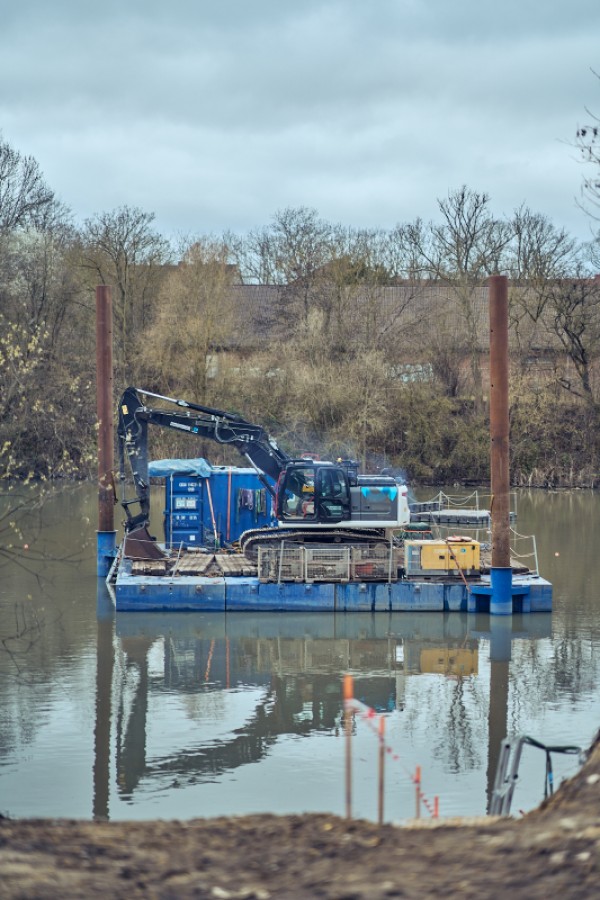
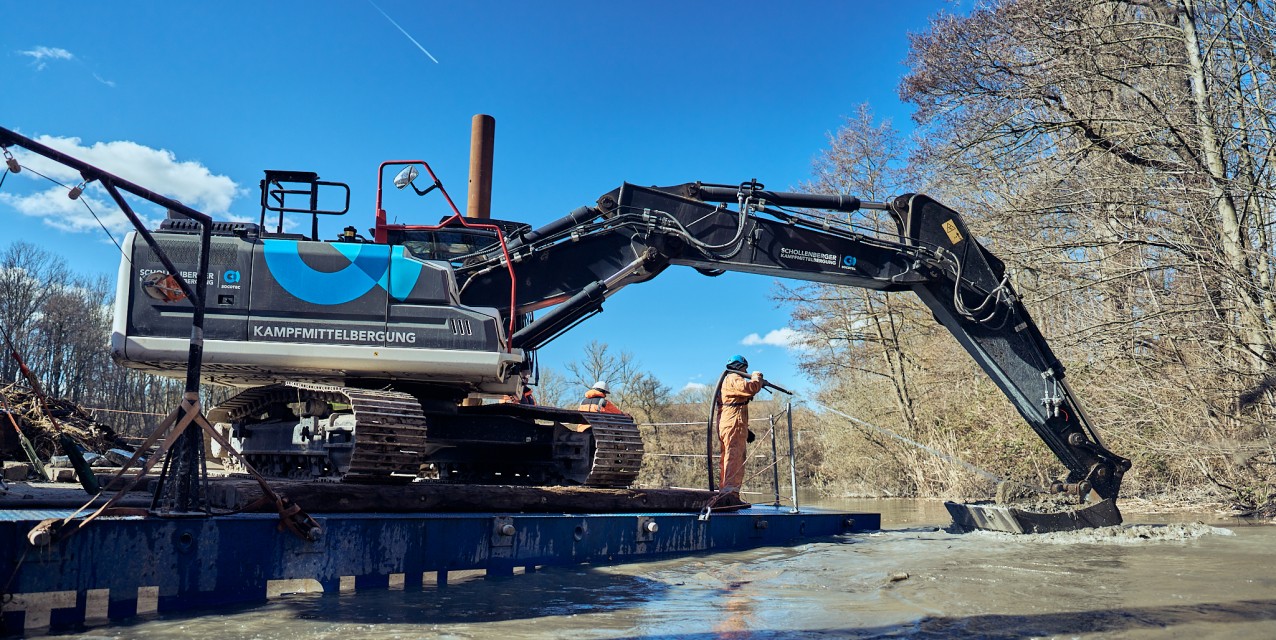
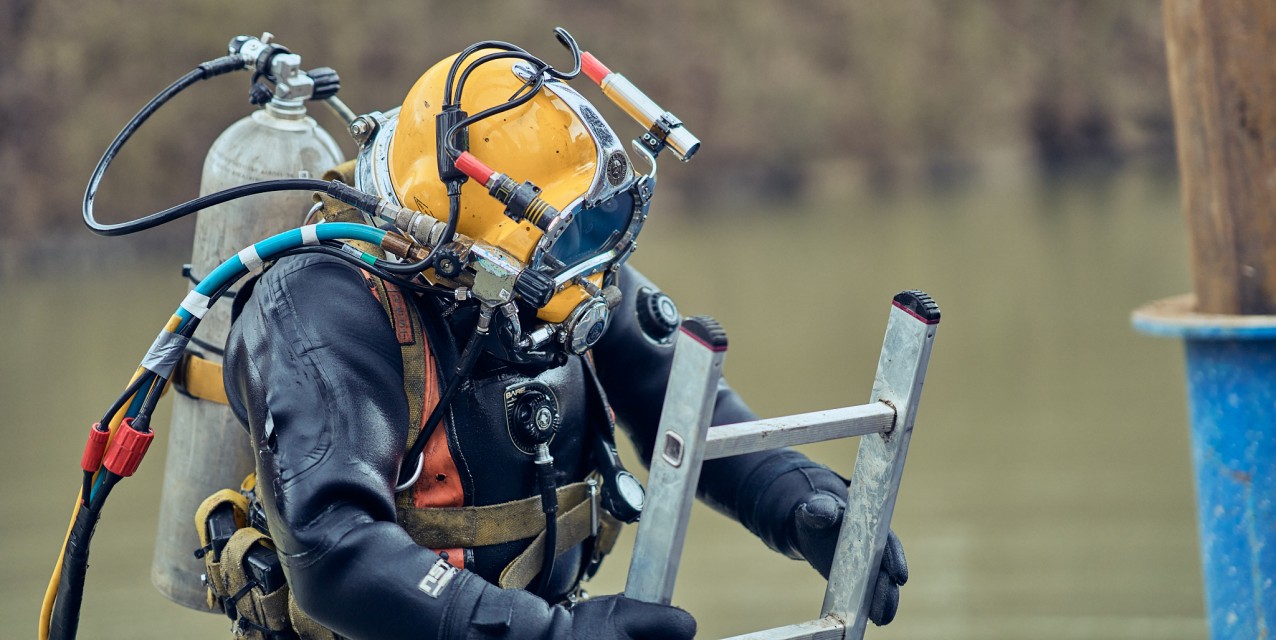
The underwater work presented a particular challenge. A state-of-the-art 5-channel probe array was deployed for precise area probing, operated from a boat across the water surface. Since the probing depth varied between 0.7 and 2.3 meters depending on water level, additional measures were required for complete clearance below the sediment. The identified anomalies were partly located beneath the basin floor and concealed by a meter-thick layer of sludge. To identify these suspected locations, deep probing with an additional drilling device was necessary. Subsequently, an elaborate flushing process had to be carried out. Our experts resolved this through the use of specialized floating equipment, with excavators positioned on floating platforms. In this context, larger objects were first examined by divers and then carefully excavated using the excavators, so they could subsequently be safely recovered.
The initial situation for the unexploded ordnance disposal work at the stormwater retention basins proved complex due to several on-site factors:
The underwater work presented a particular challenge. A state-of-the-art 5-channel probe array was deployed for precise area probing, operated from a boat across the water surface. Since the probing depth varied between 0.7 and 2.3 meters depending on water level, additional measures were required for complete clearance below the sediment. The identified anomalies were partly located beneath the basin floor and concealed by a meter-thick layer of sludge. To identify these suspected locations, deep probing with an additional drilling device was necessary. Subsequently, an elaborate flushing process had to be carried out. Our experts resolved this through the use of specialized floating equipment, with excavators positioned on floating platforms. In this context, larger objects were first examined by divers and then carefully excavated using the excavators, so they could subsequently be safely recovered.
Green Trust

This is a GREEN TRUST project. Learn more about GREEN TRUST by SOCOTEC and how we reduce emissions, conserve resources, and support ecological and energy transformation in construction, real estate, and infrastructure projects through our solutions.

Want to know more about our services in Germany ?

