Controlled demolition of a power plant chimney in Frimmersdorf, Germany
Quality assurance in the course of the controlled demolition of a 200-metre-high chimney at the former power plant Frimmersdorf.
At the site of the former lignite power plant Frimmersdorf, a roughly 200-metre-high chimney was brought down in a controlled operation using a folding-type blast demolition. With a mass of more than 14,000 tonnes and its multi-shell construction, the structure held specific challenges for the planning and execution of the demolition.
We were responsible for a continuous quality assurance throughout the planning and execution process. With control calculations, simulations, review of the blasting concepts, and supervision of the works on site, the planned demolition was accompanied in an independent way.

Talk to our experts

Key Information
- Project name: Power plant chimney in Frimmersdorf, Germany
- Client: RWE Power AG
- Location: Grevenbroich-Frimmersdorf, Germany
Services provided:
- Assessment/review of the planned demolition and the demolition concept
- Assessment/review of structural safety during the demolition process
- Consulting service with regard to the planned demolition method
- Consulting service regarding the planned blasting concepts, the projected collapse behaviour, and the effects of the blast demolition on adjacent structures and infrastructure
- Consulting service regarding required protective measures
- Review of the blasting design and the blasting concept
- Independent inspection and approval of the drilling, blasting, and protective measures on site
- Independent confirmation of the blasting result
- Holistic documentation
Project Details
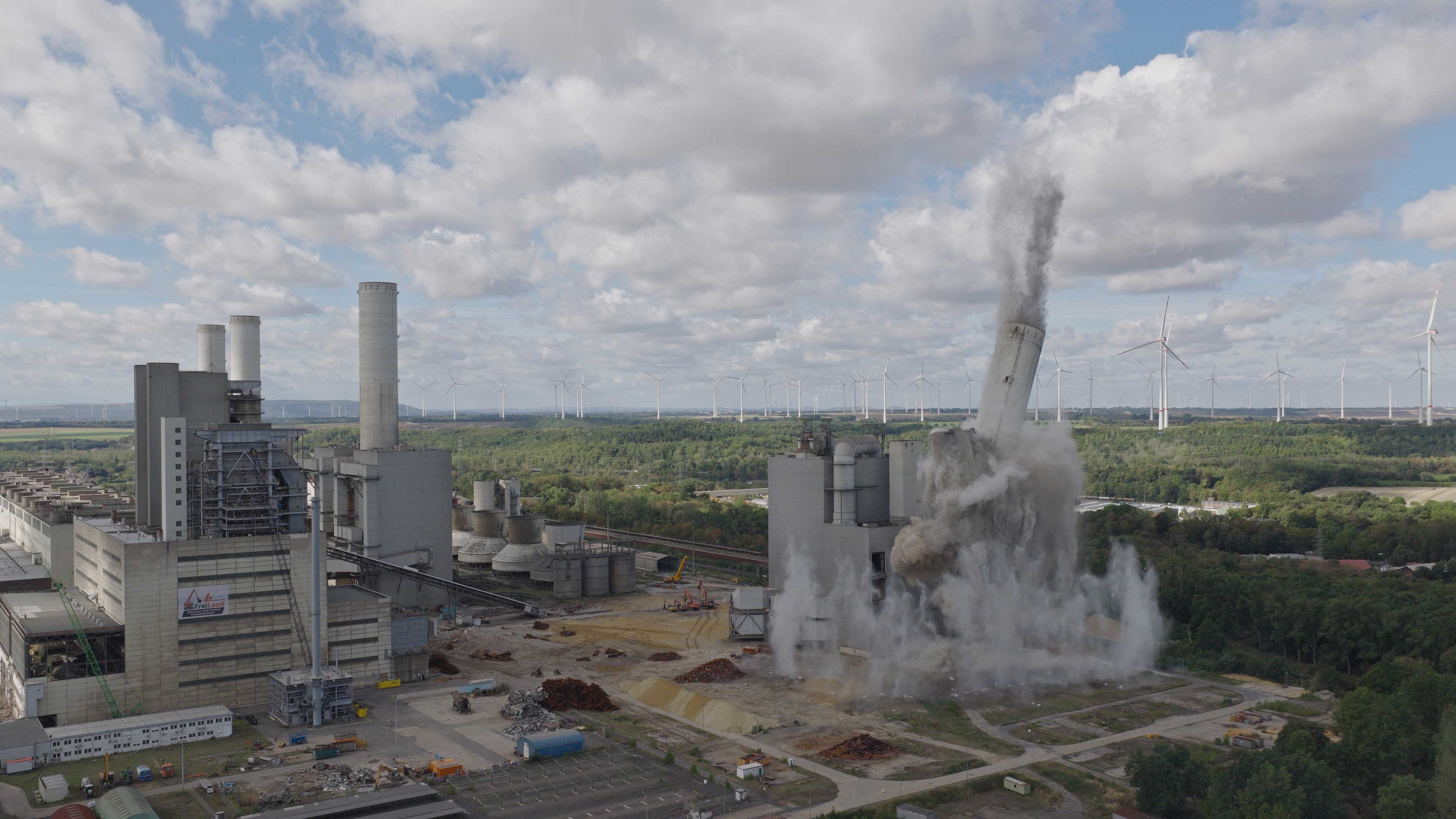
The roughly 200-metre-high chimney at the former lignite power plant Frimmersdorf was built with an outer reinforced concrete support tube and two inner, oval masonry flue gas tubes. With a mass of more than 14,000 tonnes and its multi-shell construction – which had not been dismantled beforehand – the structure held specific challenges on the controlled demolition.
For the chosen blasting, the structure had to be prepared in the preferred way in which the collapse would take up as little space as possible and the effects on the surroundings would remain limited.
A specific boundary condition was the adjacent river Erft, located immediately in the northwest of the chimney, which was not allowed to be affected.
At the same time, the power plant site contained buildings and building parts listed as historic buildings, which caused that the vibrations arising from the impact of the collapsing structure also had to be limited.
Thus, the appropriate and chosen blasting technology was a folding-type collapse.
Quality assurance for a precisely planned demolition
We were commissioned for a continuous quality assurance across the entire planning and execution process. This included reviewing and commenting on the detailed execution planning for the blasting, calculations on pre-weakening measures, and reviewing protective and securing measures. In addition, control calculations and simulations were carried for an independent proof of the planning.
A particular technical challenge of the project was the preparation of the blasting at a height of around 100 metres. Therefore, a complex ignition system had to be implemented for the outer support tube and the two inner masonry flue gas tubes. The different ignition delay stages of the closely spaced components had to be precisely coordinated with one another to ensure a safe ignition.
The position of the first inner tube at the front of the blast opening, which was unfavourable for the intended direction of fall, also showed a particular challenge for everyone involved.
In addition to the reviewing process of the planning, we accompanied the execution on site. This included checking the blasting preparations, the drilling and charging works, the setup of the ignition circuit, and the installation of the protective measures.
After the blasting, the present result was compared with the comparative analyses and simulations prepared in advance as part of the quality assurance process. A site inspection with the responsible blasting company as well as drone flights confirmed the desired outcome: the demolition matched well to the previously reviewed calculations.
The result demonstrated what quality assurance can do in a demolition project of this scale: it increases safety through independent technical review, forward-looking assessment and advice, as well as on-site support in all decisive steps.
In this context, quality assurance is part of a large project team that has to face many challenges on the way to a successful demolition.
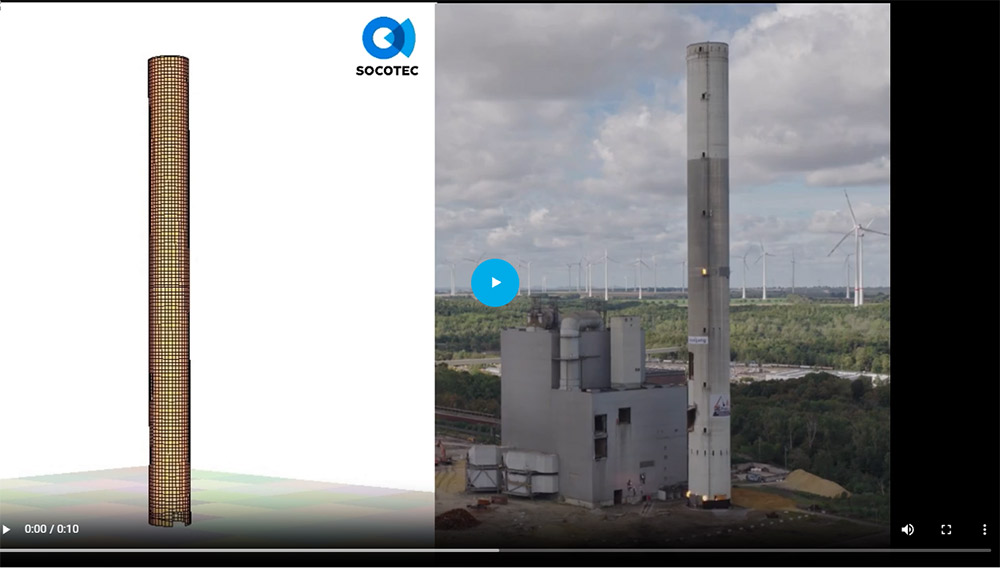
Demolition of the Frimmersdorf power station chimney
Explore more projects and technical capabilities in Germany
Photo and video credits: RWE Power AG