
La Casa de les Lletres: Sustainability consultancy in Barcelona, Spain
The project transforms Barcelona’s historic Palau Requesens into a cultural hub dedicated to literature while preserving its heritage. SOCOTEC supports the renovation through its GREEN TRUST framework, targeting high sustainability standards and BREEAM certification. Using life cycle assessment and low-carbon strategies, the project combines historic conservation with long-term environmental performance.
Key informations
- Client: Brullet de Luna i Associats SLP + Taller d’Arquitectura a les Golfes
- Location: Barcelona, Spain
- Timeline: 2025–2028

Talk to our experts

Project overview
The historic Palau Requesens, a medieval palace protected as a Cultural Asset of National Interest in Spanish city of Barcelona, in Catalonia is undergoing a major transformation. By 2028, it will reopen as Casa de les Lletres (“House of Literature”), a cultural hub dedicated to literature and language.
The building will host the Institució de les Lletres Catalanes (ILC), a public institution that promotes Catalan literature, along with other organizations from the literary sector.
SOCOTEC is contributing to the project through its GREEN TRUST framework, providing environmental consultancy aligned with the six objectives of the European Union Taxonomy. The goal is to upgrade this 14th-century building to meet modern sustainability standards, including BREEAM certification.
Heritage meets sustainability
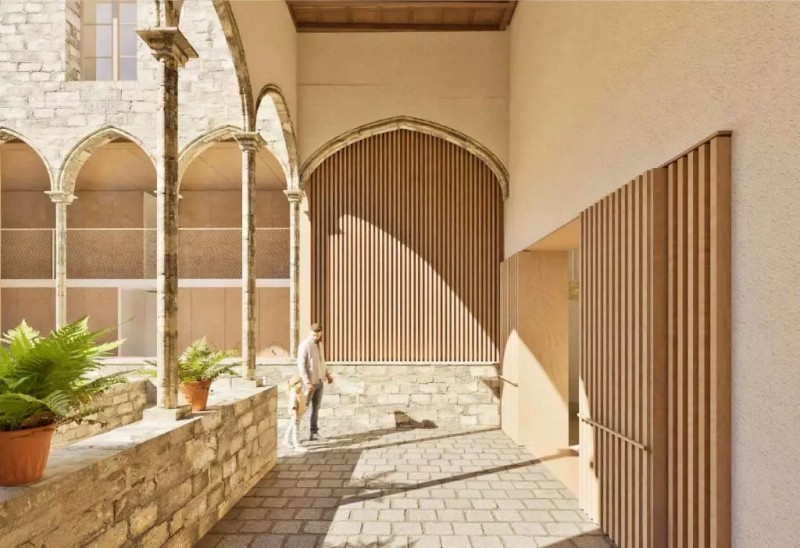
The rehabilitation project seeks to adapt the palace for contemporary public and administrative use while preserving its Gothic and Neoclassical character. Architectural strategies emphasize natural light, passive energy efficiency, and respect for historical elements.
SOCOTEC’s role focuses on ensuring that all interventions meet high environmental standards, combining heritage conservation with long-term sustainability performance.
Spatial and sustainability strategy
The redesigned building is organized to function as a dynamic cultural space aligned with global decarbonization targets for 2050:

1# Ground Floor – Public Core
A multipurpose hall and café will activate the Gothic courtyard. Restored historic openings will enhance natural daylight at street level.
2# First Floor – Cultural Heritage
This level will house the Reial Acadèmia de Bones Lletres (Royal Academy of Letters), featuring a double-height library that restores Gothic arches and improves passive thermal comfort.
3# Second and Third Floors – Workspaces
Offices for the ILC will be positioned along the façade to maximize daylight and enable natural cross-ventilation, reducing reliance on mechanical systems.
4# Roof – Green Infrastructure
The roof will incorporate green roofing systems to improve insulation and reduce heat gain, contributing to urban climate resilience.
Our work at Palau Requesens focuses on reducing the carbon footprint during both construction and operation. This is not just about restoring a historic building, but about ensuring its resilience to climate challenges. By applying Life Cycle Assessment (LCA), we evaluate every material and process. This level of precision ensures that a centuries-old structure can meet 21st-century standards of comfort, efficiency, and sustainability.
Carbon Assessment: ensuring environmental viability
To guarantee long-term performance and compliance with international standards, SOCOTEC applies a rigorous carbon analysis based on Life Cycle Assessment (LCA). This methodology evaluates the building’s environmental impact across four key stages.
A model for sustainable Heritage
This project is a tangible example of GREEN TRUST in action, demonstrating how historic preservation can align with the environmental objectives of the European Union.
By combining architectural sensitivity with advanced sustainability strategies, the transformation of Palau Requesens sets a benchmark for the future of heritage rehabilitation.
Discover our monitoring services in Spain

